


Everything Started Awesome
Half-Time Reset
1.5 Million Or Bust
The housing market started 2024 with everything looking awesome – at least for estate agents and mortgage lenders. Mortgage rates were on a downwards trajectory, house price falls were easing, and buyer demand was up. However, the rate shock for those reaching the end of their fixed rate period was still severe and private renters were increasingly stretched – with those that could find the deposit also stretching themselves with higher mortgage repayments to become first time buyers. The Spring budget brought little relief and rates also started creeping upwards. Despite the increase in rates, activity continued to recover and a General Election was called – marking a half-time reset in both the year and decade. June saw the return of inflation back down to its 2% target and interest rates continued their downwards trajectory. In July the new Labour majority government quickly jumped on planning reform and other policy changes as they attempt to hit their 1.5 million new homes target. After a wet summer, the autumn saw mortgage rates fall further and activity continue to rise – with a rush of completions ahead of the Autumn Budget. Activity levels returned to their pre-pandemic levels and the housing market recovery looked set to continue into 2025 – at least until interest rates started rising again.
Everything Started Awesome
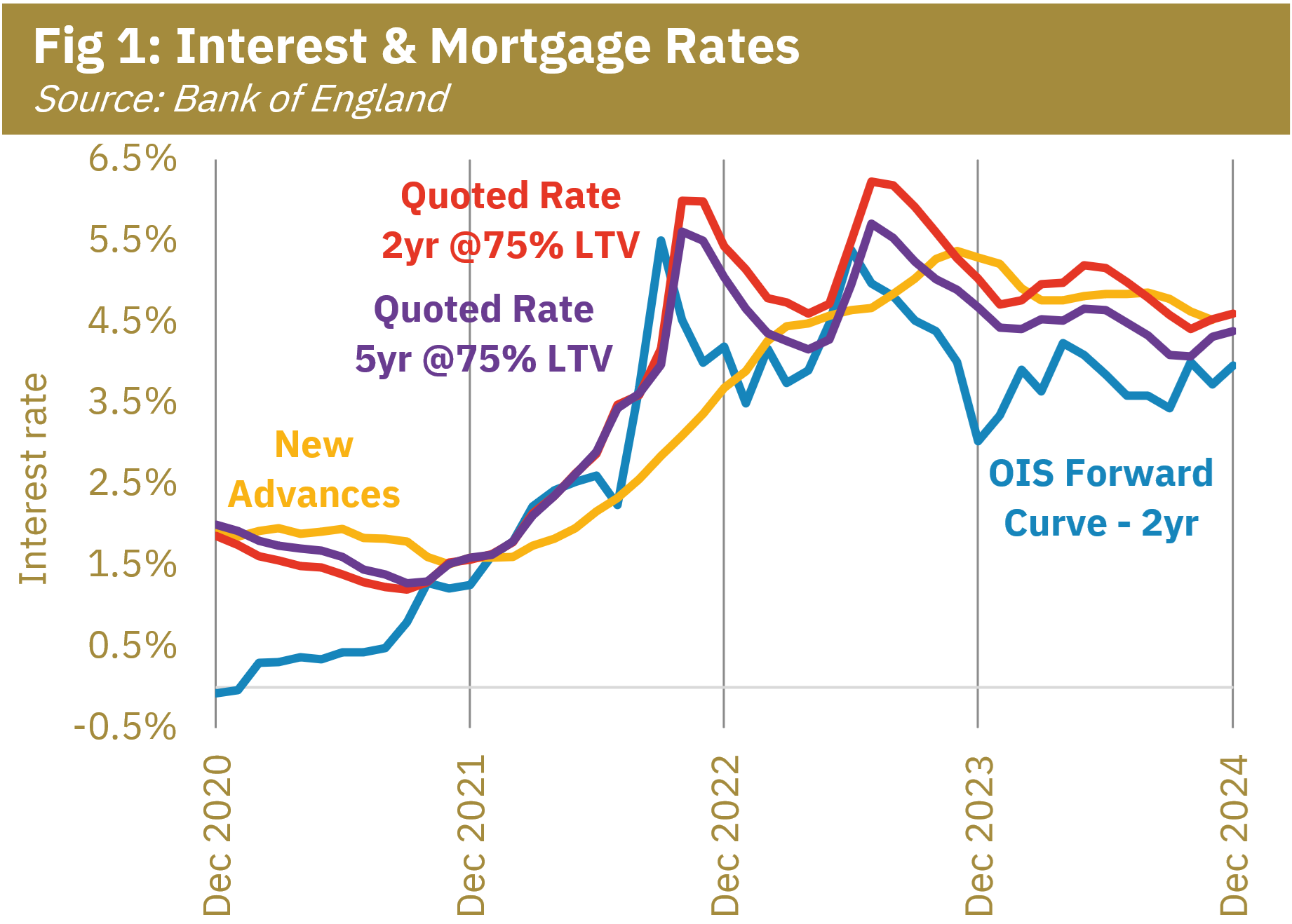
2024 started with everything looking positive. Interest rate expectations – the two-year OIS Forward Curve in Fig 1 – had fallen sharply in late 2023, continuing their downward trend started in mid 2023. Mortgage rates had followed and both available quoted mortgage rates and the actual, though lagged, rates on new advances continued to ease in the early months of 2024. As a result of the falling interest rates, the housing market continued to recovery – with both house price falls easing and activity levels picking up. Awesome news for anyone involved in the business of buying and selling homes though perhaps less so for those hoping for a big correction to reset house price affordability.
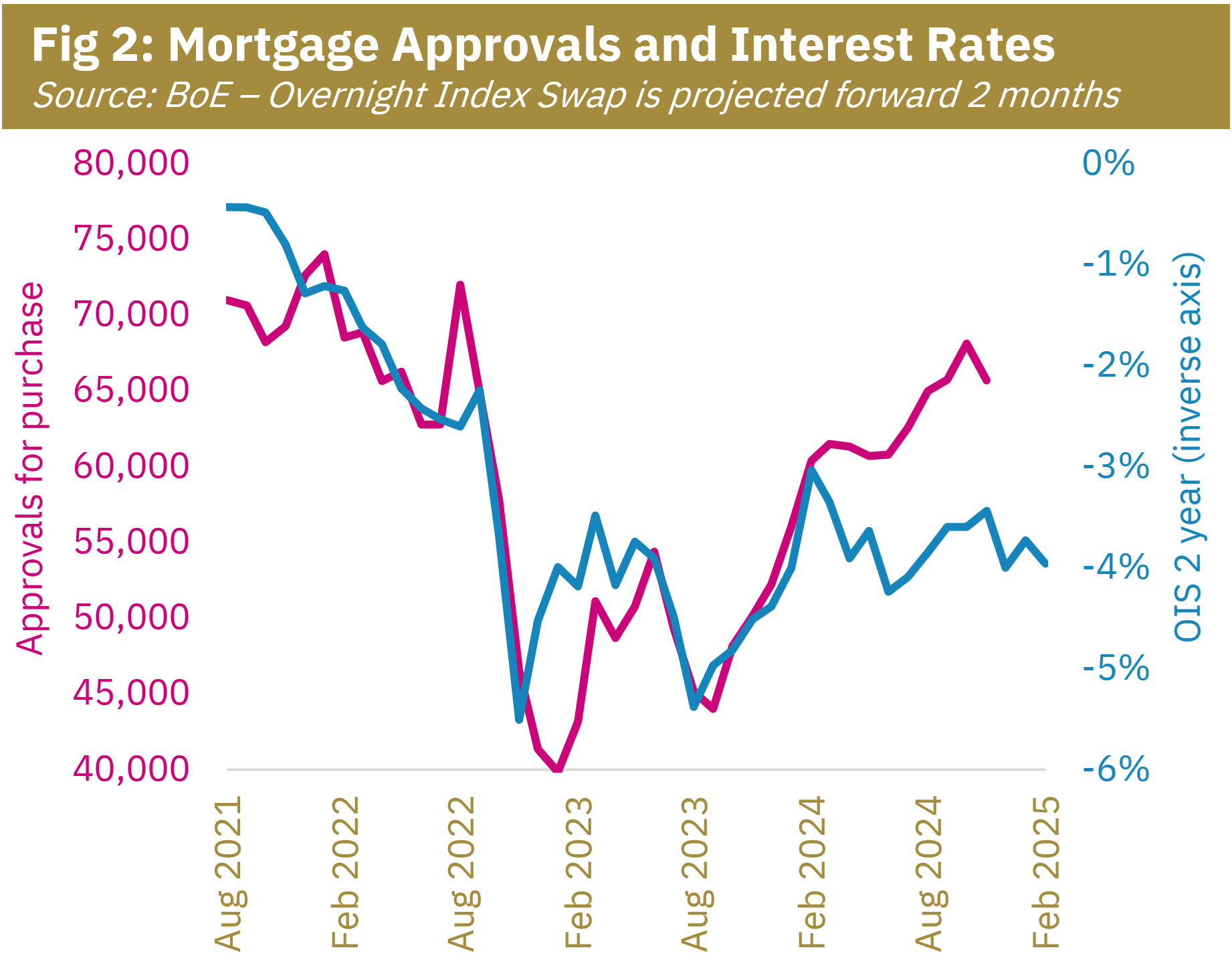
As interest rates fell, activity levels in the market improved but, when rates started rising again, the recovery in activity continued. As Fig 2 shows, the trajectory of mortgage approvals has closely followed the inverse of interest rate in recent years. Early 2024 saw this relationship continue as listings companies reported both higher levels of buyer demand and sales agreed. Some of the larger deposit-based mortgage lenders also began to price their mortgages more aggressively in an attempt to capture market share from their market-based competitors. However, as rates started to rise again in Q2 2024, the recovery continued. It is still not clear how much of this increase in activity represents a sustained recovery or just the backlog in demand from the 300,000 fewer sales recorded during the preceding two years.
Regional Variation
The recovery in both house prices and transactions was clear in the national data but, with mortgage rates still elevated, there were clear regional differences in outcomes. As expected prior to the mortgage rate rises, the market in the south of England was more exposed while borrowers in the north of England and rest of the UK tended to borrow lower multiples of their incomes – the higher the loan-to-income ratio, the greater the effect of higher rates. As a result, the impact of higher rates has hit potential and existing borrowers more in the south of England, resulting in bigger falls in house prices, transactions, and housebuilding activity.
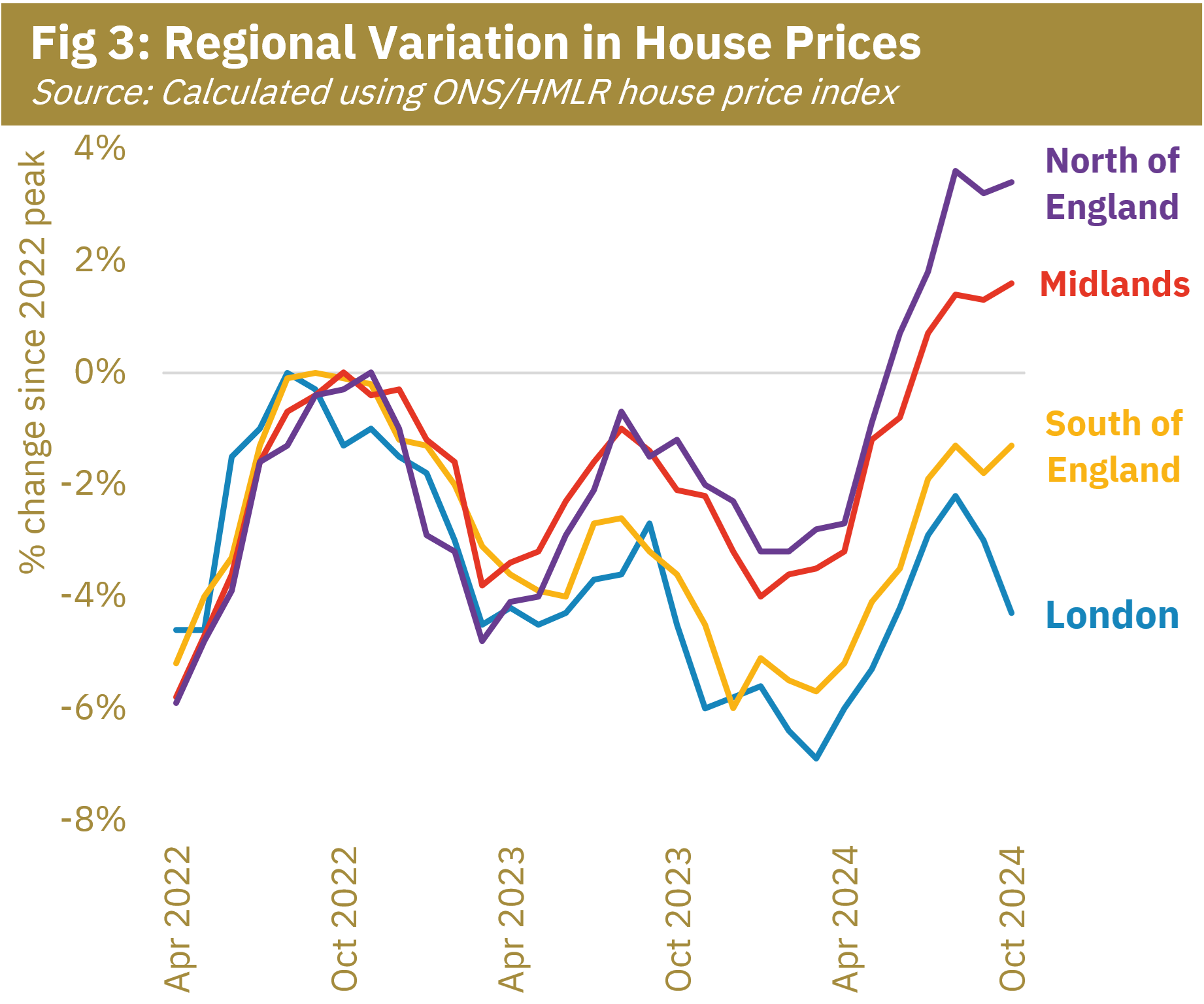
As Fig 3 shows, the initial house price falls in late 2022 and early 2023 were broadly similar across all regions in England. However, the trajectories since then have diverged with the ONS reporting the strongest recovery in house prices in the north of England – with house prices now 3.4% higher than their previous 2022 peak. Meanwhiles, prices in London and the south of England have recovered but they remain below their 2022 peak by -4.2% and -1.3% respectively.
It is worth noting that the ONS house price index is currently compromised by a severe lag in registrations by the Land Registry and so is subject to significant revisions. As a result, it is quite possible that the recent fall in London house prices is revised away by future data releases. However, the overall regional pattern is also reflected by other house price indices such as Nationwide.
Half-Time Reset
Housing policy had a feeling of stagnation during the first half of the year. There was a consultation on reforms to social housing allocations – later dismissed as they would “not only fail to deliver any meaningful improvements to how social housing is allocated but would likely result in a range of negative impacts” – along with yet more brownfield first policies and a boost to funding for affordable housing. The Spring Budget brought some tax changes but there was a growing sense of frustration from the housebuilding industry and an increasing preference for a change in government. Rishi Sunak jumped earlier than expected a general election was called.
The 2024 general election marked the half-way point of the year, and the result ended the Conservatives’ 14 years in power with a Labour majority. Labour quickly set out their housing plans with planning reforms, housing targets, and more – as they attempt to hit their target of 1.5 million new homes during the parliament – while reforms also sought to improve life for renters and leaseholders.
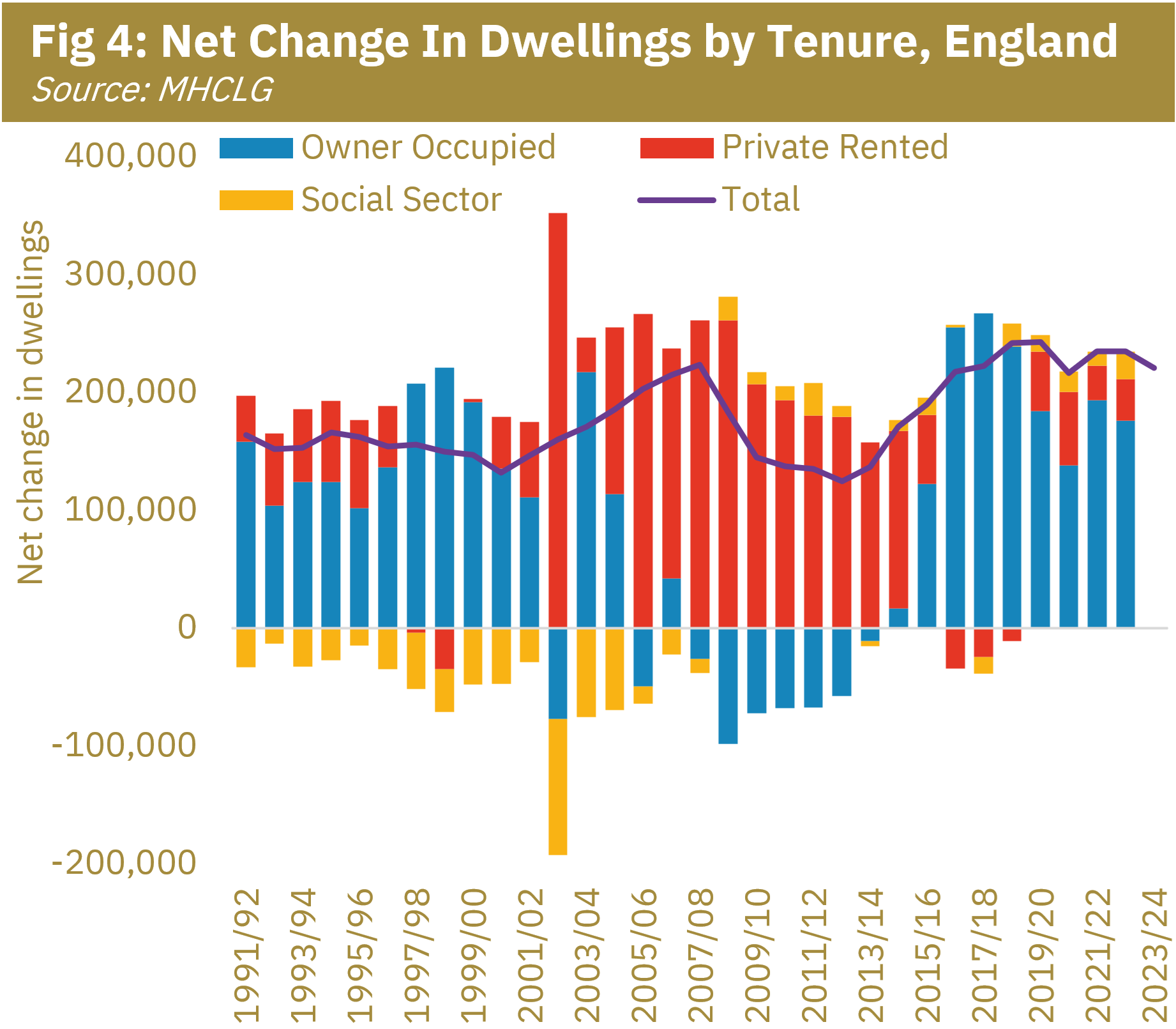
Housing policy under the Conservatives had been focussed on homeownership. Policies such as Help-to-Buy sought to increase homeownership while the rented sectors were intentionally squeezed. As a result, the net change in the housing stock by tenure during this period was largely an increase in owner occupation – a big shift compared to the previous Labour years when it was mostly an increase in private renting. The current policy approach suggests future years will see a broader profile of tenure.
1.5 Million Or Bust
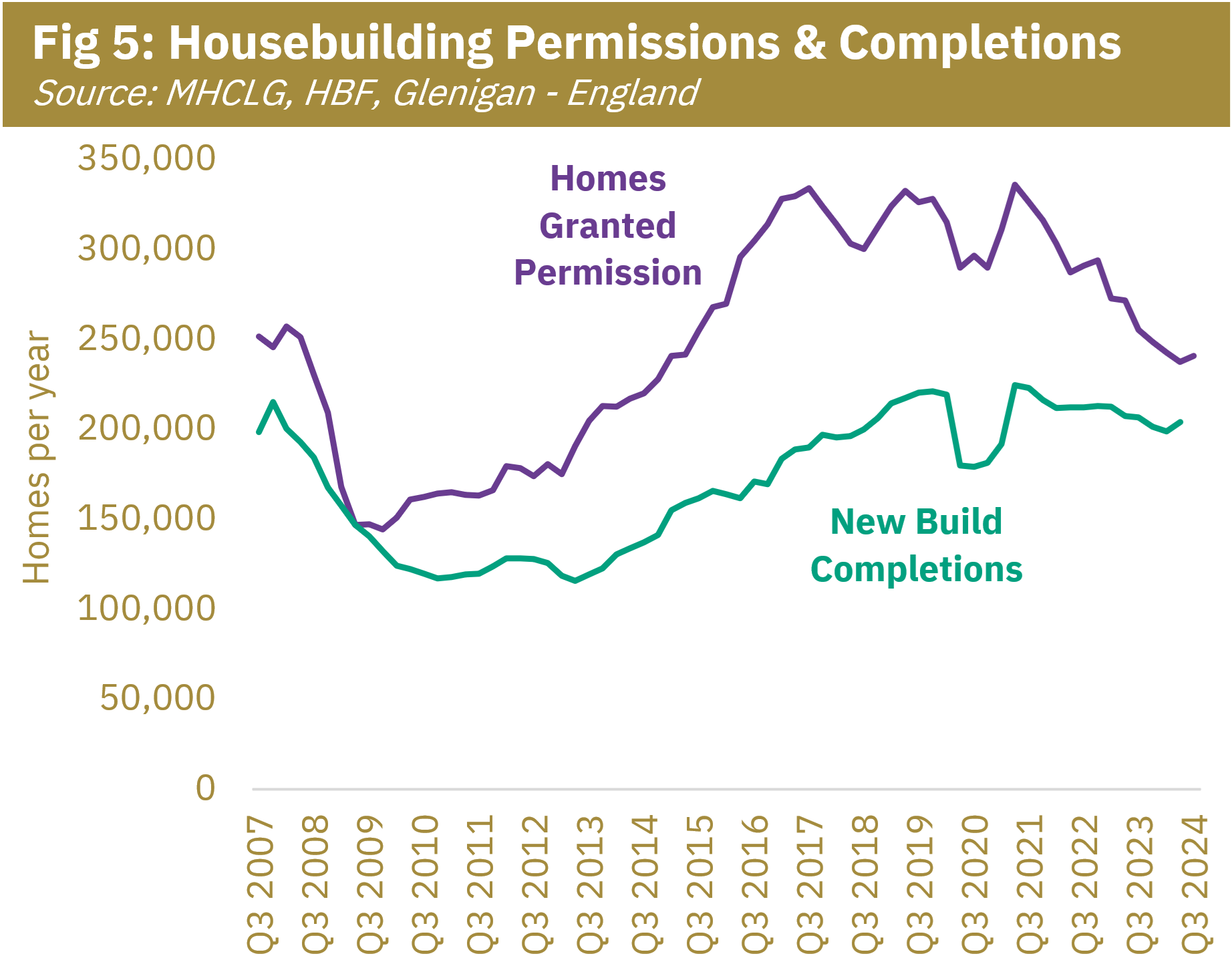
The Labour government set an English housing delivery target of 1.5 million net new homes over the course of the parliament. Despite the widespread belief that this target is unachievable – including by this analyst – the Prime Minister recommitted to this target in his December “missions” speech. Perhaps the biggest challenge with the target is the starting point. Housing delivery has fallen in recent years, with new build completions down and the latest weekly new build Energy Performance Certificate (EPCs) data – a leading indicator for net additions – suggesting there were 217,209 new homes in 2024. A further challenge is that the biggest falls in delivery have been in the regions that are most in need of new homes. For example, the number of new build EPCs in the South East during 2024 was 34,800 – the lowest level since June 2016.
So far, the government’s plans to increase housebuilding have focussed on planning reforms. This is understandable as the availability of land to build on is an important component of building new homes and the number of homes granted planning permission has fallen substantially since 2021. However, it is not the only one and the importance of construction capacity – both materials and labour – and the finance to fund the construction and purchase of the new homes are equally important.
Housebuilders are now struggling to find buyers for their S106 affordable housing due to the pressures on housing associations –with a clearing service now launched – and there are also growing calls for a new version of the Help-to-Buy equity loan as buyers struggle to afford the still high house prices demanded by housebuilders.
First-Time Buyers & The Mortgage Market
The pressures facing prospective first-time buyers have been massive for decades. The cost of buying (i.e. the deposit) has been the biggest barrier since the financial crisis but the rise in mortgage rates means that first time buyers are now having to pay a much higher proportion of their income on repayments and their cost of owning is now well above normal levels – for more on this check out my 2024 report for the BSA.
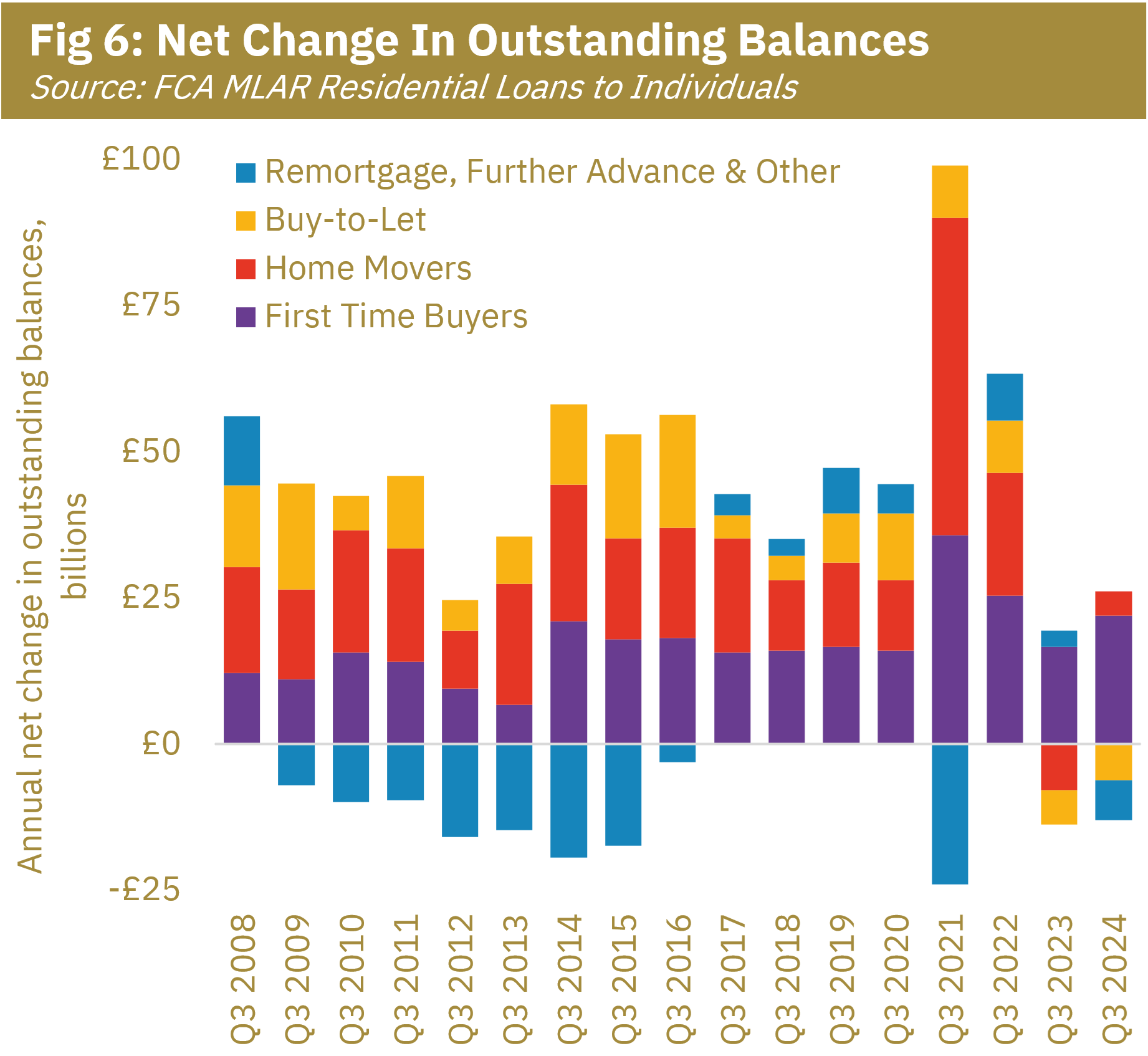
Despite the challenges facing prospective first-time buyers, they have been a key feature of the housing market in 2024. At a time when discretionary buyers have been incentivised to stay where they are thanks to existing low fixed rate mortgages, first time buyers have remained in the market, albeit at lower levels than normal. The Yorkshire Building Society recently estimated there had been 330,000 mortgaged first-time buyer completions in 2024. This was an increase on the 290,000 recorded in 2023 but still below normal levels.
The first-time buyer market has also been key to the mortgage market’s continued growth, with the FCA’s MLAR data showing that the majority of the net increase in outstanding lending over the last two years was to first-time buyers (Fig 5). As such, lenders have focussed on trying to encourage more through different products but their attempts are limited by the underlying unaffordability of house prices.
Private Renters
One of the drivers for prospective first-time buyers to make the jump in 2024 – despite the affordability barriers – is that the situation in the private rented sector is far worse. Rents have risen rapidly since the pandemic amidst a lack of homes available to rent. While the story of landlords selling homes had been overstated – it was more about consolidation with fewer landlords owning the same number of homes – the increase in rates has led to a reduction in the size of the private rented sector but not by enough to fully account for the collapse in the number of rental listings. Other factors including longer tenancies, a fall in the use of listing companies, and shifts to short-term lets will also have played a part. Irrespective of the causes, it is clear that rents have risen rapidly.
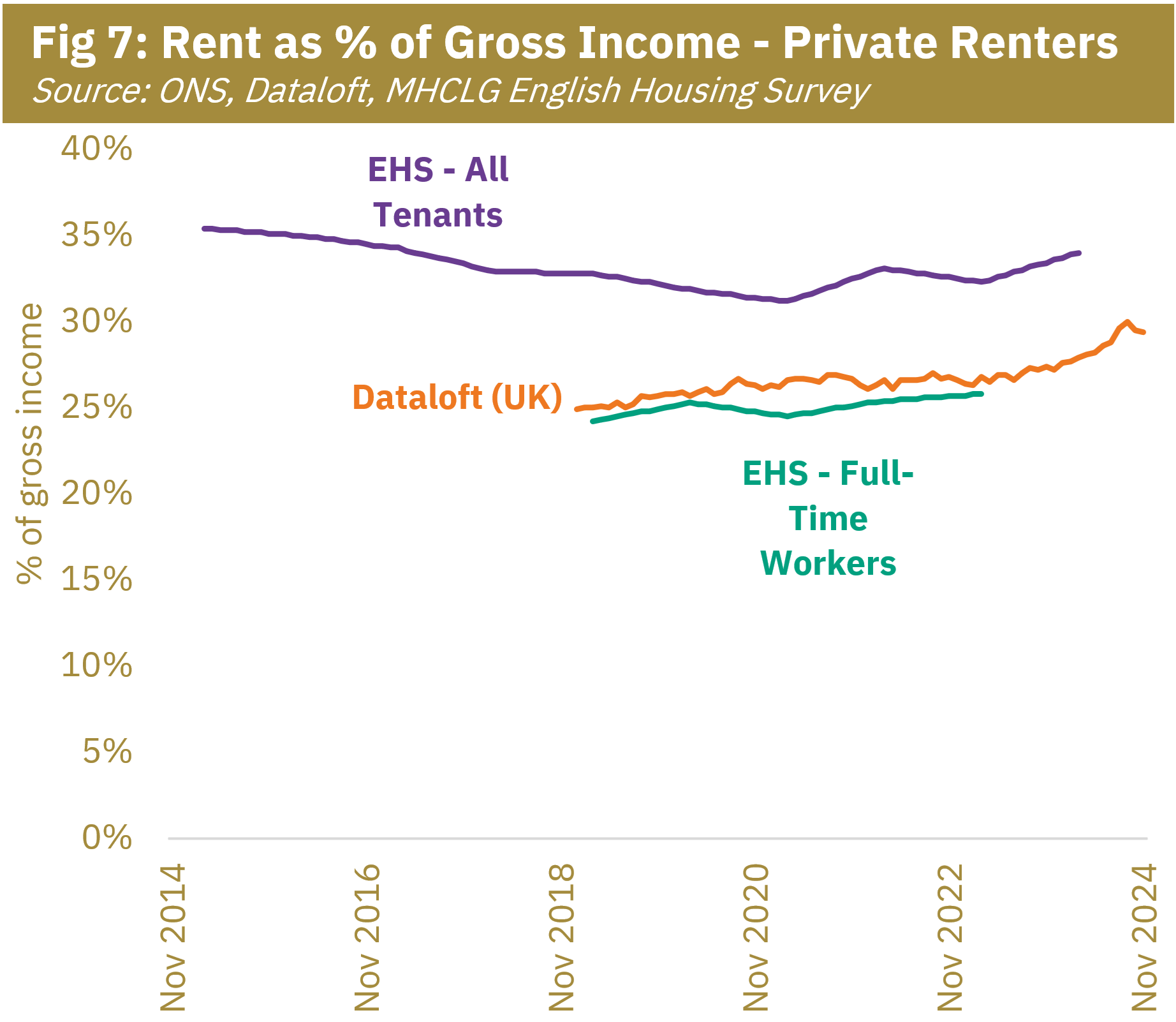
With the rise in rents, it is no surprise that rental affordability has become increasingly stretched. Dataloft data published by the ONS shows that the average proportion of gross income that renters spend on rent rose from 27.2% in December 2023 to a peak of 30.0% in September 2024. There are now signs that rents may be easing with headline measures reporting slower growth and Dataloft reporting that affordability fell slightly, to 29.4% in November 2024.
At first glance, the Dataloft affordability measures appear to be too low compared to the more frequently used English Housing Survey (EHS) data showing that the typical spend is more like 34%. However, the Dataloft data closely matches the EHS data for full-time workers – a more accurate and meaningful comparison given they are the largest group of private renters and the income of other tenant groups such as students can be misrepresented.
The Future Is Orange
The third quarter of 2024 saw mortgage rates continue to ease and activity levels return to normal pre-pandemic levels – thanks in part to a rush to complete before the Autumn Budget. However, immediate fears about higher taxes were misplaced beyond a small increase in the higher rates of Stamp Duty for additional dwellings (3% to 5%). The bigger concern since the Budget has been the rise in interest rates. Gilt yields and interest rate expectations have increased, leading to an increase in mortgage rates. While beyond the scope of our expertise, these rises appear to reflect both domestic and international concerns, with fears about the global inflationary pressures of the second Donald Trump term and worries about the state of the UK economy, with the need for more spending and tax rises in the future. Yet again, we start a new year by saying everything is uncertain.
Last year we noted that the prospects for the housing market in 2024 were more positive than they had been the previous year, with the potential for higher price growth if rates eased. Mortgage rates didn’t fall to the 3% levels required for our double-digit price growth scenario but the Nationwide index ended the year up 4.7% with average rates around 4.5%. If mortgage rates do fall further then house prices could end up much higher but it currently appears more likely that we’re stuck in a higher interest rate environment.
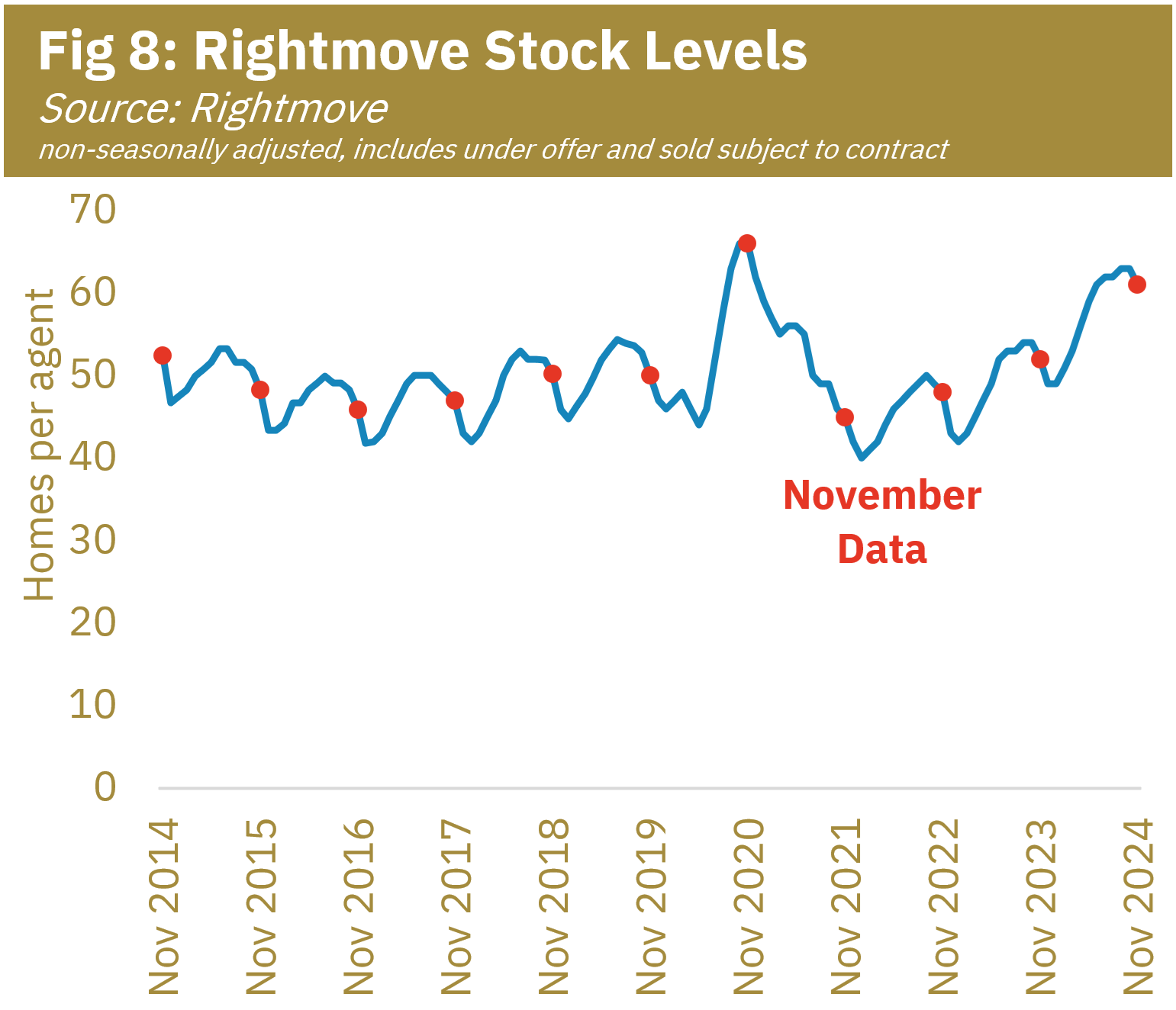
In the short-term, it’s likely that housing market activity will continue at current levels, especially as first-time buyers rush to beat the stamp duty threshold change in April. But interest rates stuck at current levels will put further pressure on consumer activity and the economy while the number of homes available to buy continues to rise within its usual seasonal patterns (Fig 8). This suggests to us that the most likely outlook is stagnation.
Market At A Glance
Economy – UK
The ONS estimated monthly GDP increased 1.3% in the year to October 2024. Monthly GDP was 2.7% above the pre-pandemic peak recorded in January 2020. However, this monthly data will continue to be revised in the future.
House Prices - UK
Rightmove reported a 1.4% annual rise in asking house prices in December 2024 while Nationwide reported a 4.7% annual rise in their mortgage approval based index over the same period. Meanwhile, the ONS reported a 3.4% annual rise in its sales agreed index for the year to October 2024..
Transactions – UK
HMRC provisionally reported 100,400 residential transactions in October. This was 2% higher than the same month in 2019. Meanwhile, the Bank of England reported mortgage approvals for house purchase were just 1% lower in November 2024 than the same month in 2019.